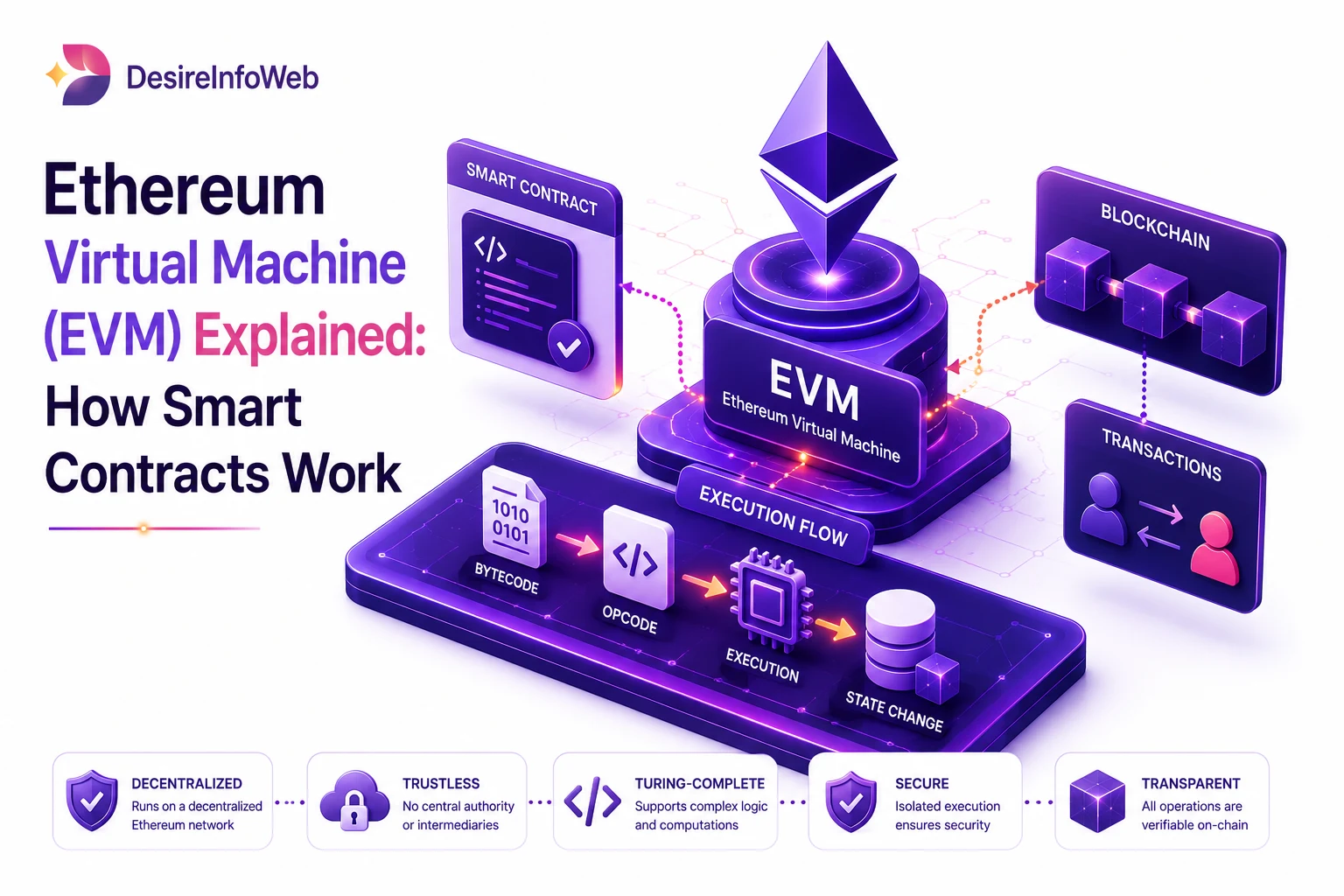
Ethereum Virtual Machine (EVM)
The Ethereum Virtual Machine, commonly known as the EVM, is the runtime environment that executes smart contracts on Ethereum.
It is one of the core technologies that makes Ethereum programmable.
You can think of the EVM as:
- a decentralized global computer
- an execution engine for smart contracts
the environment where blockchain applications run
Why the EVM Was Created
Unlike traditional blockchains that mainly focus on recording transactions, Ethereum was designed to support:
- smart contracts
- decentralized applications (DApps)
- programmable blockchain logic
To make this possible, Ethereum required a system capable of:
- reading smart contract code
- executing instructions
- updating Blockchain data consistently across all nodes
This system is the: Ethereum Virtual Machine (EVM)
What Does the EVM Do?
The EVM is responsible for executing and managing smart contract operations on the Ethereum network.
1. Reading Smart Contract Code
When developers write smart contracts using languages like Solidity, the code is compiled into bytecode.
The EVM reads and understands this bytecode.
2. Executing Smart Contracts
The EVM executes the logic defined inside smart contracts.
IF payment received → Grant access
The EVM processes these instructions exactly as programmed inside the smart contract.
Every Ethereum Node Runs the EVM
3. Updating Blockchain State
After executing smart contract logic, the EVM updates the blockchain state.
This may include:
- wallet balances
- ownership records
- stored contract data
- token transfers
4. Calculating Gas Usage
Every operation executed by the EVM consumes computational resources.
The EVM calculates:
- how much gas is required
- how much computational work is performed
More complex operations require more gas.
Every Ethereum Node Runs the EVM
One of Ethereum’s most important features is consistency.
Every Ethereum node:
- runs the EVM
- executes the same smart contract code
- produces the same result
This ensures that blockchain data remains synchronized across the entire network.
Why the EVM Is Important
The EVM is what transforms Ethereum from:
- a simple cryptocurrency network
into:
- a programmable blockchain platform
Because of the EVM:
- developers can build decentralized applications
- smart contracts execute automatically
- blockchain logic becomes standardized
- applications run consistently across all nodes
Simple Analogy
Think of a smart contract as:
- an application or program
EVM
Think of the EVM as:
- the operating system or runtime environment that executes the application
Similar to:
- how a browser runs web applications
- how a JVM runs Java programs
the EVM runs Ethereum smart contracts.
How Smart Contracts Reach the EVM

The process generally works like this:
Step 1 — Write Smart Contract
Developers write smart contracts using Solidity.
Step 2 — Compile the Code
The Solidity code is compiled into EVM bytecode.
Step 3 — Deploy to Ethereum
The smart contract is deployed onto the blockchain.
Step 4 — EVM Executes the Code
Whenever users interact with the contract, the EVM executes the contract logic.
EVM-Compatible Blockchains
The success of Ethereum’s virtual machine led many other blockchain networks to adopt EVM compatibility.
Examples include:
- Polygon
- BNB Chain
- Avalanche C-Chain
- Arbitrum
- Optimism
These blockchains support Ethereum-style smart contracts and Solidity development.
Benefits of the EVM
Standardized Execution
Smart contracts behave consistently across all Ethereum nodes.
Developer Ecosystem
Developers can build decentralized applications using widely adopted tools and languages.
Interoperability
EVM-compatible blockchains allow developers to reuse Ethereum applications and tools.
Decentralized Automation
Applications can run automatically without centralized control.
Real-World Example
Suppose a user interacts with a decentralized application:
The EVM:
- executes the contract logic
- validates operations
- calculates gas usage
- updates blockchain records
All of this happens in a decentralized environment.
Conclusion
The Ethereum Virtual Machine (EVM) is the core execution engine of Ethereum.
It enables:
- smart contract execution
- decentralized applications
- programmable blockchain systems
By ensuring that all Ethereum nodes execute the same logic consistently, the EVM makes Ethereum one of the most powerful and flexible blockchain ecosystems in the world.