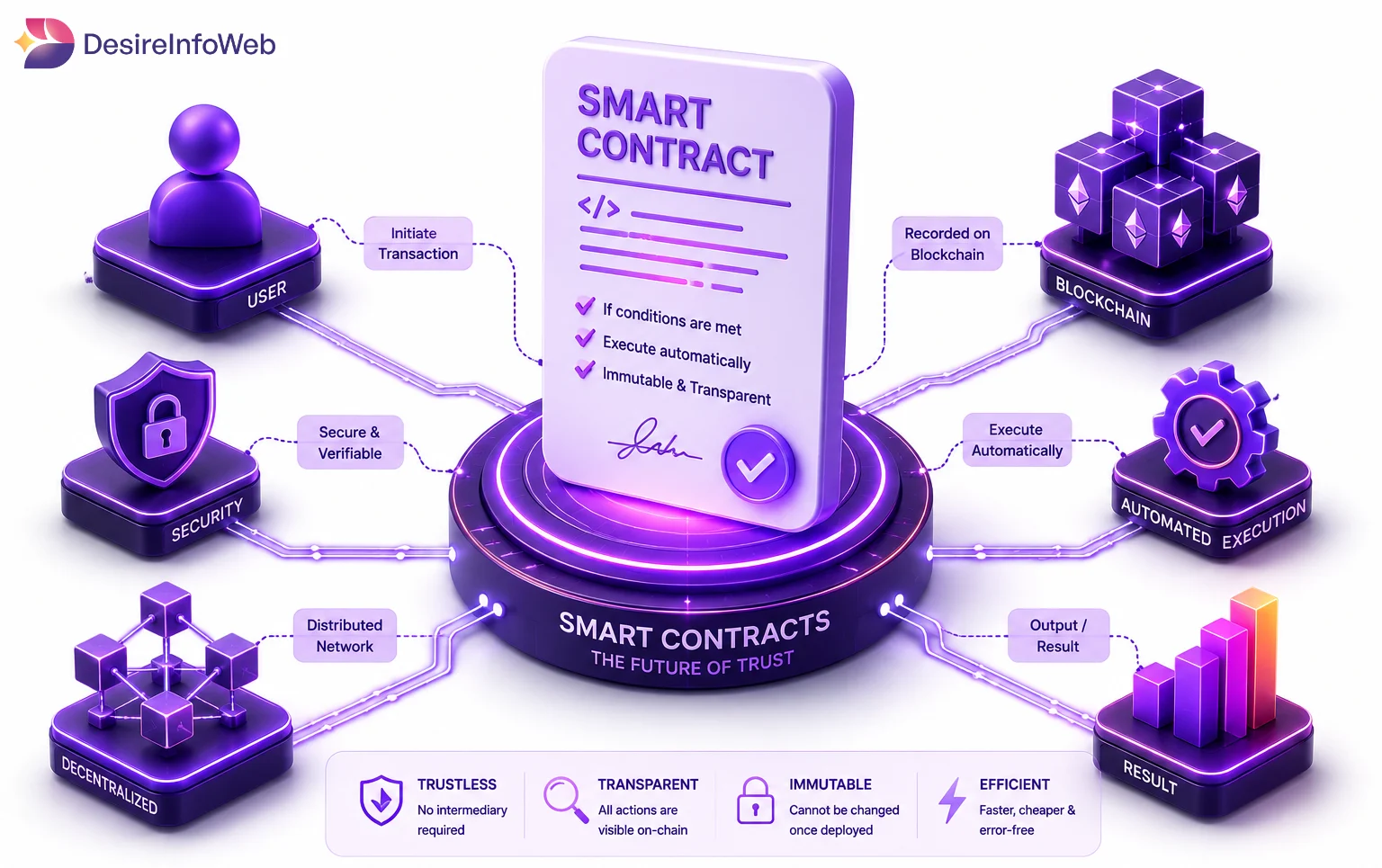
Smart contracts are self-executing programs stored and executed on a blockchain.
They contain:
- business logic
- predefined rules
- stored data
and automatically execute actions when specific conditions are met.
Smart contracts are one of the most important innovations introduced by Ethereum because they allow blockchain networks to go beyond simple digital payments.
Smart contracts are self-executing programs stored and executed on a blockchain. They automatically perform predefined actions when specific conditions are met, enabling decentralized automation without requiring a central authority.
What is a Smart Contract?
A smart contract is a program deployed on the blockchain that automatically performs operations according to predefined conditions.
Unlike traditional applications, smart contracts:
- run in a decentralized environment
- are executed by the blockchain network
- do not require a central authority to operate
Simple Example of a Smart Contract
IF payment is received → THEN grant ownership or access
Example use cases:
- granting course access after payment
- releasing digital assets automatically
- transferring ownership records
- processing decentralized financial transactions
The execution happens automatically based on programmed conditions.
How Smart Contracts Work
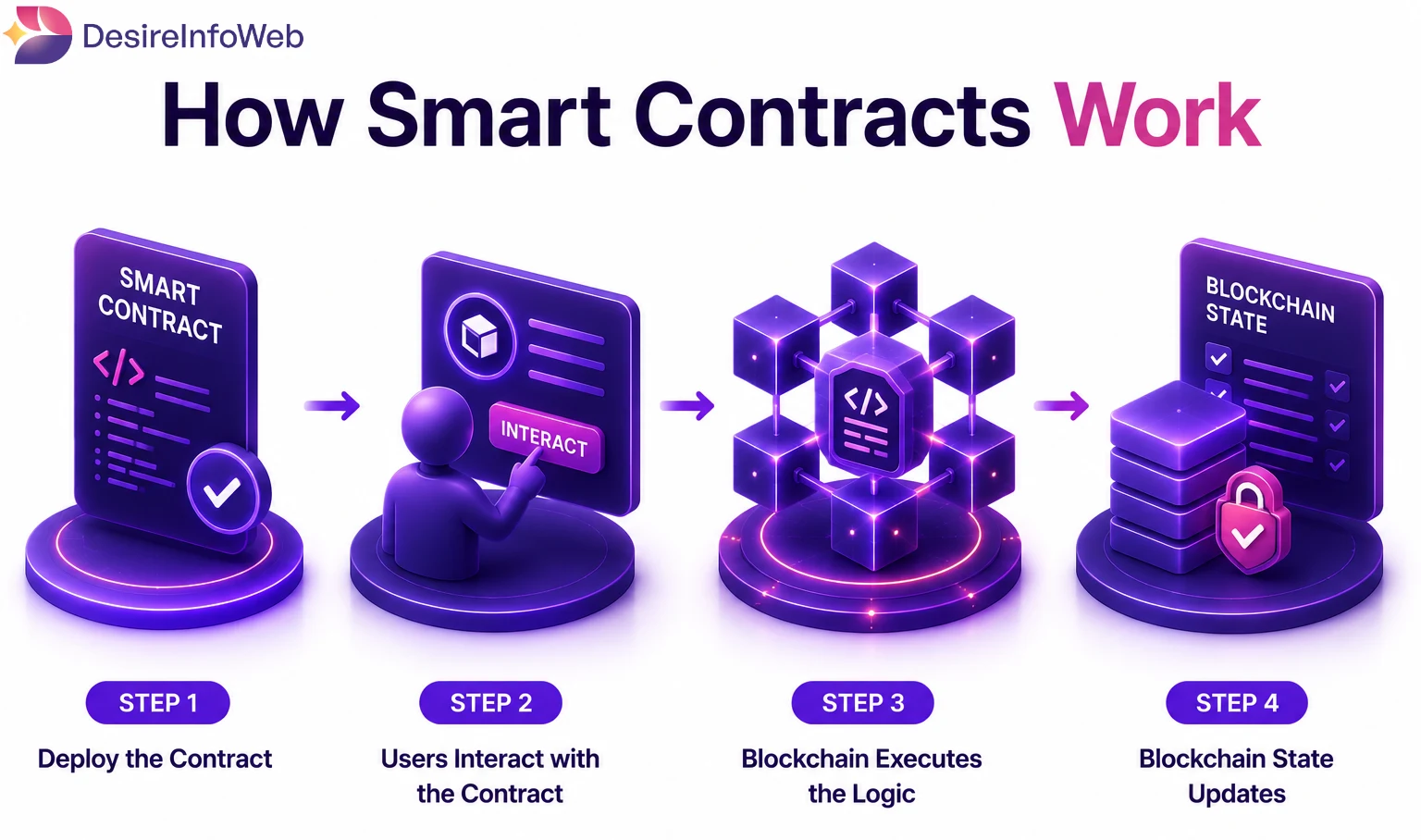
The basic smart contract flow looks like this:
Step 1 — Deploy the Contract
A developer writes and deploys the smart contract onto the blockchain.
Step 2 — Users Interact with the Contract
Users send transactions to the contract.
Example:
- sending payment
- calling a function
- submitting information
Step 3 — Blockchain Executes the Logic
The blockchain network executes the contract rules through the EVM (Ethereum Virtual Machine).
Step 4 — Blockchain State Updates
If conditions are satisfied:
- balances may change
- ownership may transfer
- data may update
- events may be recorded
All operations become part of the blockchain permanently
Important Characteristics of Smart Contracts
1. Stored on the Blockchain
Smart contracts exist directly on the blockchain network instead of a centralized server.
This makes them:
- decentralized
- transparent
- distributed across nodes
2. Automatically Executed
Once triggered, smart contracts execute automatically according to programmed logic.
No manual approval is required.
3. Transparent
The contract code is publicly visible on the blockchain.
This allows users to:
- inspect logic
- verify rules
- understand how the application behaves
4. Immutable After Deployment
After deployment, modifying a smart contract becomes difficult.
This helps maintain:
- consistency
- trust
- tamper resistance
Because of this, Smart Contract testing and auditing are extremely important.
5. Requires Gas Fees
Executing smart contracts consumes computational resources.
Users pay gas fees using ETH to execute blockchain operations.
Smart contract testing and auditing are extremely important because deployed contracts are difficult to modify.
Smart Contracts vs Traditional Backend Systems
| Traditional Backend | Smart Contracts |
| Runs on centralized servers | Runs on blockchain nodes |
| Controlled by one organization | Distributed across the network |
| Can be modified internally | Difficult to modify after deployment |
| Limited transparency | Publicly visible logic |
| Depends on server trust | Depends on blockchain consensus |
Simple Analogy
You can think of a smart contract as:
- backend business logic running on the blockchain
Instead of:
Server → Database → Application Logic
Blockchain applications work like:
Blockchain → Smart Contract Logic → Decentralized Execution
Common Use Cases of Smart Contracts
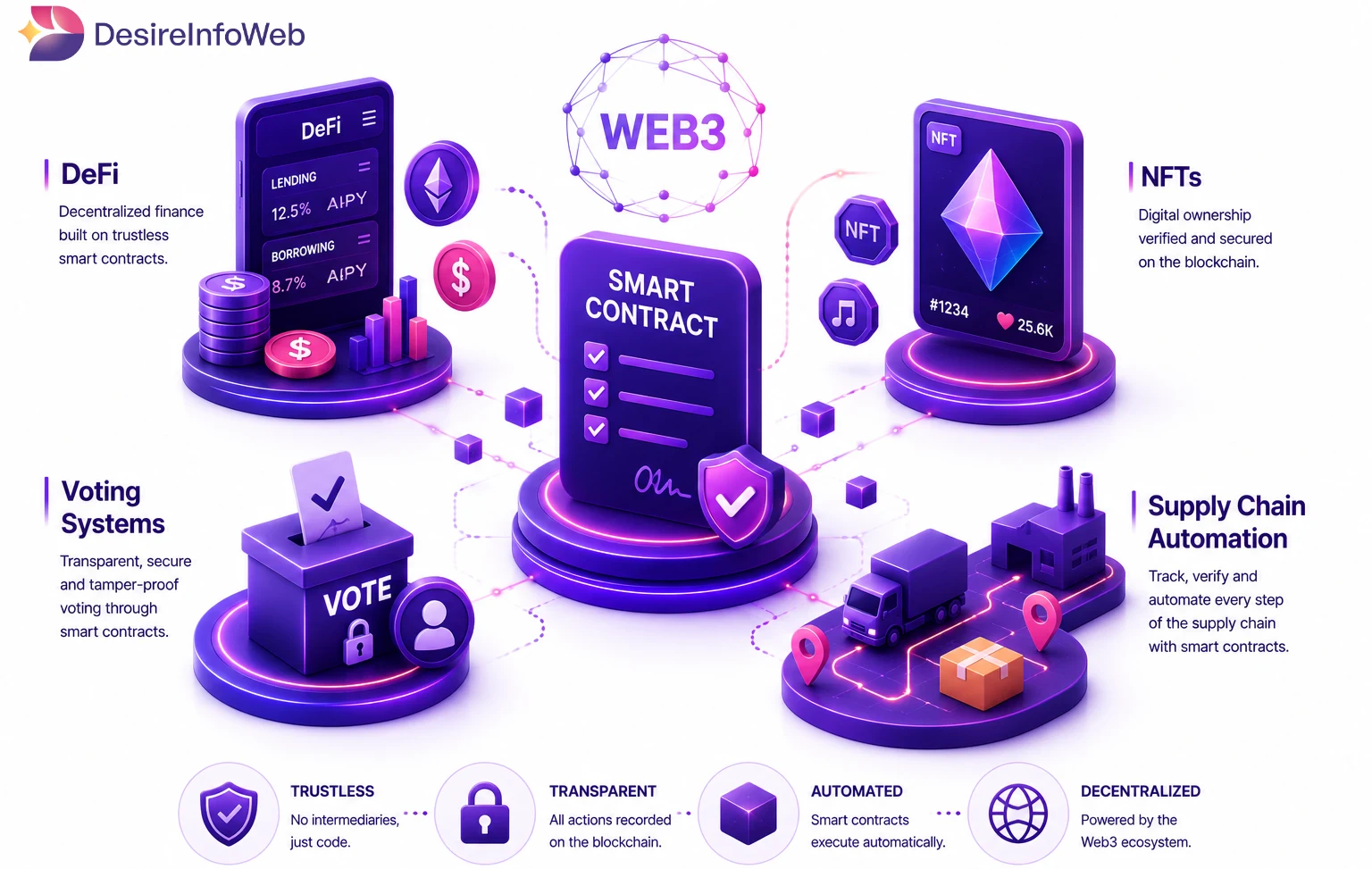
Decentralized Finance (DeFi)
Used for:
- lending
- borrowing
- token swapping
- decentralized exchanges
NFTs (Non-Fungible Tokens)
Smart contracts manage:
- digital ownership
- NFT minting
- transfers
Voting Systems
Can automate:
- vote collection
- result verification
- transparent counting
Supply Chain Applications
Used for:
- tracking goods
- automating verification processes
- maintaining immutable records
Subscription & Access Systems
Example:
Payment Successful → Subscription Activated
Benefits of Smart Contracts
Reduced Dependency on Intermediaries
Processes can execute automatically without centralized authorities.
Improved Transparency
Rules are visible and verifiable on the blockchain.
Increased Security
Blockchain-based execution reduces risks of unauthorized modifications.
Automation
Smart contracts automate business logic and reduce manual operations.
Limitations of Smart Contracts
Although powerful, smart contracts also have challenges.
Difficult to Modify
Bugs in deployed contracts can be difficult to fix.
Gas Costs
Complex smart contracts may become expensive to execute.
Security Risks
Poorly written contracts may contain vulnerabilities.
This is why:
- testing
- auditing
- security reviews
are extremely important in blockchain development.
Why Smart Contracts Matter
Smart contracts transformed blockchain from:
- a payment-focused technology
into:
- a programmable decentralized ecosystem
They became the foundation for:
- Web3
- decentralized applications (DApps)
- DeFi
- NFTs
blockchain automation systems
Conclusion
Smart contracts are self-executing blockchain programs that automatically enforce predefined rules and conditions.
They enable:
- decentralized automation
- transparent execution
- trustless interactions
- programmable blockchain applications
By combining Blockchain Security with programmable logic, smart contracts became one of the most revolutionary concepts in modern blockchain technology.