Introduction
Artificial Intelligence is transforming how organizations manage information, automate workflows, and deliver intelligent customer experiences. As businesses increasingly adopt AI-powered applications, one common question arises:
Both approaches help improve the performance of Large Language Models (LLMs), but they serve different purposes and business requirements. Understanding the differences between RAG vs Fine-Tuning can help organizations make informed decisions, reduce implementation costs, and maximize AI investments.
In this guide, we'll explore how RAG and Fine-Tuning work, their advantages, limitations, and when each approach makes the most sense for your business.
Understanding Retrieval-Augmented Generation (RAG)
Retrieval-Augmented Generation (RAG) is an advanced AI framework that enhances language models by connecting them to external business knowledge sources before generating responses. Instead of relying only on the information learned during training, a RAG system retrieves relevant data from company resources such as knowledge bases, internal documents, customer support content, CRM systems, policies, reports, and other enterprise repositories.
A useful way to think about RAG is as an AI assistant with access to a company's digital library. When a user asks a question, the system first searches for the most relevant information and then uses that data to generate an accurate and context-aware response. This approach is particularly valuable for startups, small and medium-sized businesses, and large enterprises that manage frequently changing information.
One of the key benefits of RAG is its ability to deliver up-to-date answers without retraining the underlying AI model. When organizations update operational procedures, compliance documents, product information, pricing details, or internal guidelines, the AI can immediately reference the latest content available in the connected data sources.
Because business knowledge remains separate from the language model, RAG solutions are easier to maintain, more scalable, and significantly more cost-effective than repeatedly fine-tuning models. For organizations looking to build intelligent search, knowledge management, customer support, or enterprise AI assistants, RAG often serves as the most practical and efficient starting point.
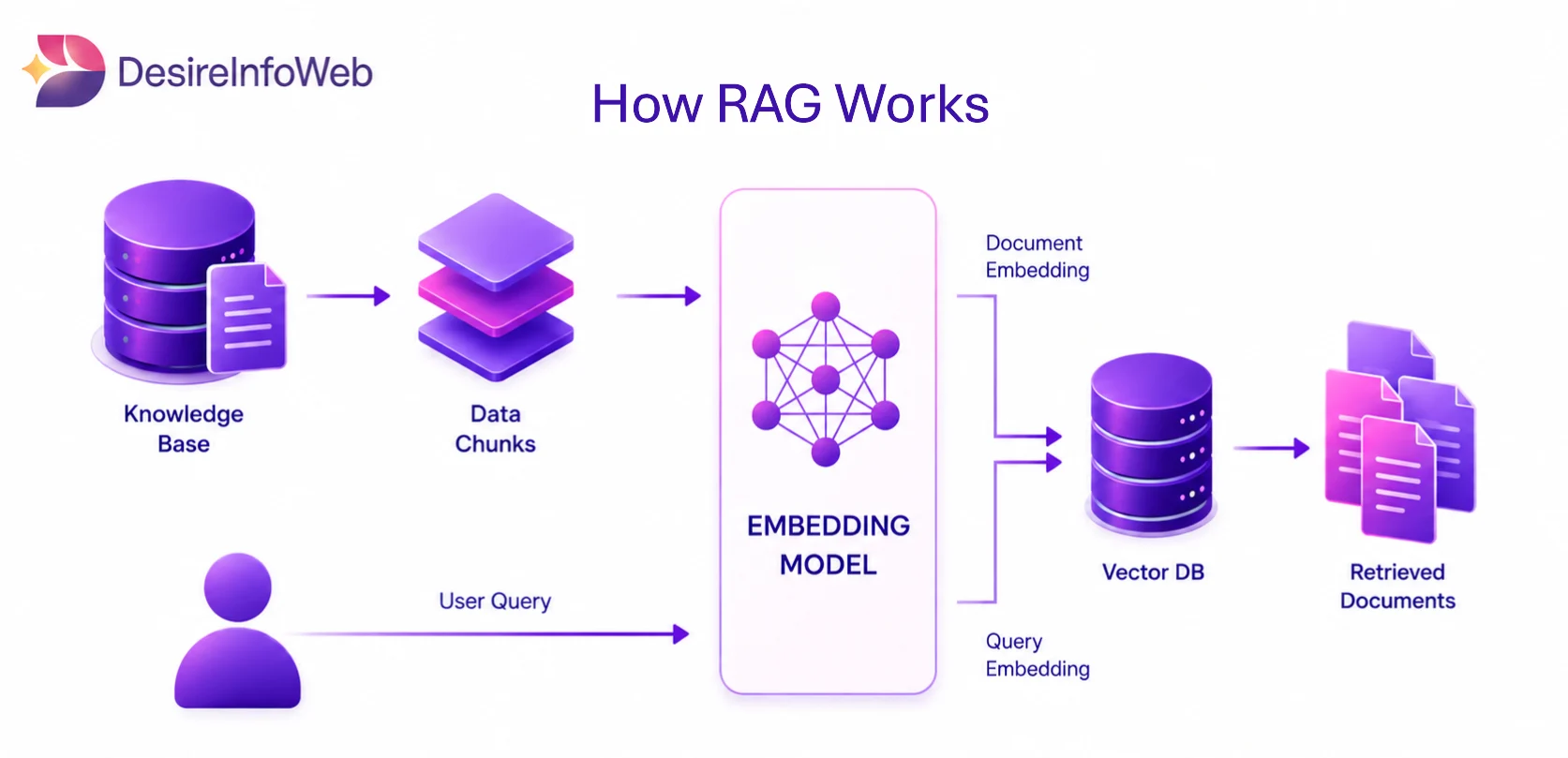
How RAG Works
- User submits a query.
- The retrieval system searches for relevant documents.
- Relevant content is extracted and sent to the AI model.
- The model generates a response using retrieved information.
This process allows AI applications to provide responses based on the latest and most accurate business data.
What is Fine-Tuning?
Fine-tuning is a method of customizing an AI model by training it on industry-specific data, business processes, and organizational requirements. This additional training helps the model understand specialized terminology, preferred communication styles, operational workflows, and domain-specific knowledge, enabling it to deliver more relevant and consistent responses.
A practical way to think about fine-tuning is like onboarding and training an experienced employee. Instead of consulting reference materials for every task, the employee learns company procedures and best practices in advance, allowing them to respond quickly and accurately. Similarly, a fine-tuned AI model develops a deeper understanding of a specific business domain and can generate responses that align with organizational standards.
Unlike Retrieval-Augmented Generation (RAG), which retrieves information from external knowledge sources at the time of a query, fine-tuning incorporates specialized knowledge and behavior directly into the model. As a result, the AI can produce responses without relying on a separate retrieval process, often leading to faster response times and greater consistency.
Organizations commonly use fine-tuning for enterprise AI assistants, industry-specific applications, workflow automation, compliance-driven environments, and business systems that require standardized outputs. When accuracy, consistency, and domain expertise are critical, fine-tuning can provide a powerful solution for delivering tailored AI experiences across the organization.
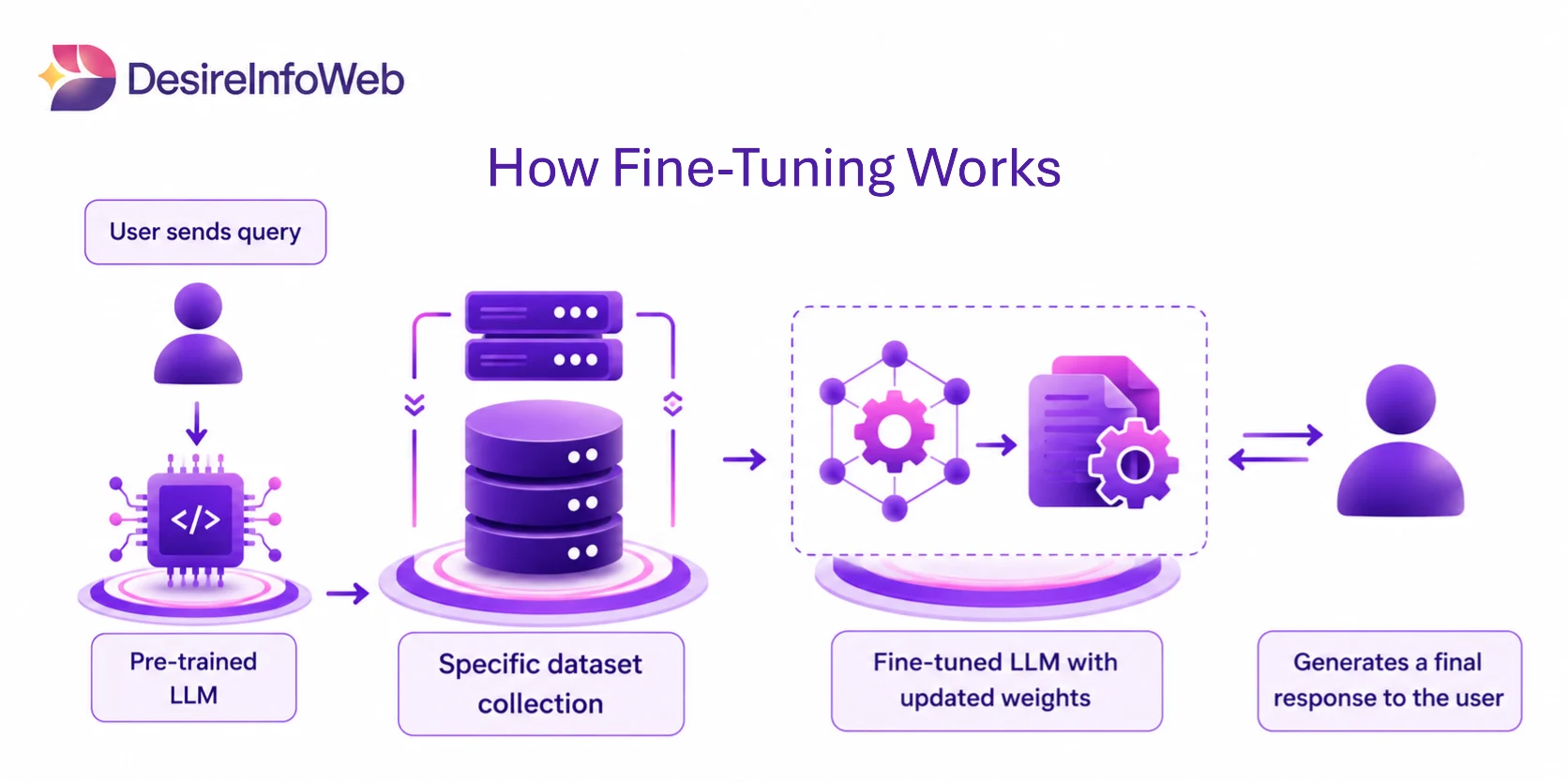
How Fine-Tuning Works
- Collect domain-specific training data.
- Prepare and clean the dataset.
- Train the base model with new data.
- Deploy the customized model for business use cases.
The result is a model that better understands industry-specific language and business processes.
RAG vs Fine-Tuning: Key Differences
Feature | RAG | Fine-Tuning |
Knowledge Source | External documents and databases | Embedded in model weights |
Data Updates | Easy and immediate | Requires retraining |
Implementation Cost | Lower | Higher |
Maintenance | Simple | More complex |
Accuracy on Current Information | High | Limited to training data |
Domain Expertise | Moderate | Strong |
Scalability | Excellent | Moderate |
Response Personalization | Good | Excellent |
RAG vs Fine-Tuning - Decision Framework
The choice between Retrieval-Augmented Generation (RAG) and fine-tuning depends on several factors, including how an organization manages its data, updates information, controls operational costs, and plans to scale AI initiatives in the future. While both approaches enhance the capabilities of enterprise AI solutions, they are designed to address different business requirements and use cases.
For startups, small and medium-sized businesses, and organizations adopting AI-driven knowledge systems for the first time, RAG is often the preferred starting point. It enables businesses to connect AI models with existing knowledge sources, making implementation faster, more flexible, and easier to maintain. Because information is retrieved from external repositories, updates to documents, policies, procedures, or business content can be reflected immediately without retraining the model.
RAG vs Fine-Tuning Decision Table
Factor | RAG Wins | Fine-Tuning Wins |
Data changes frequently | Yes | No |
Budget under $50K | Yes | No |
Need source citations | Yes | No |
Complex domain reasoning | No | Yes |
High query volume | No | Yes |
Small training dataset | Yes | No |
Regulated industry audit trails | Yes | No |
Custom terminology and tone | No | Yes |
Conclusion
The choice between RAG and Fine-Tuning depends on your business objectives, data requirements, and AI strategy.
If your organization relies on frequently changing information and wants a cost-effective AI solution, RAG is often the best choice. It provides access to current business knowledge without requiring model retraining.
If your business needs highly specialized expertise, consistent outputs, and deep domain understanding, Fine-Tuning can deliver superior performance.
For many enterprises, the most effective approach is combining both technologies to create intelligent AI solutions that are accurate, scalable, and aligned with business goals.
As Chatbot Development Services continues to grow, organizations that choose the right architecture today will be better positioned to improve productivity, automate workflows, and deliver exceptional customer experiences in the future.