Introduction
Businesses have spent years investing in automation to reduce manual work, improve efficiency, and streamline operations. From workflow automation and robotic process automation (RPA) to rule-based chatbots, traditional automation has helped organizations save time and reduce operational costs. If your team is still running the same rule-based scripts from 2019, you haven't automated your business, you've frozen it.
Automation was supposed to save time. And for a while, it did. But traditional automation hits a wall the moment something unexpected happens a format change, an edge case, an exception. It simply stops. Agentic AI doesn't stop. It thinks, decides, and adapts. And businesses that understand this difference are gaining a measurable competitive edge right now.
This guide breaks down the core differences between Agentic AI vs Traditional Automation in plain business terms, no jargon, no hype, and helps you understand which approach is right for where your operations are headed.
What Is Traditional Automation?
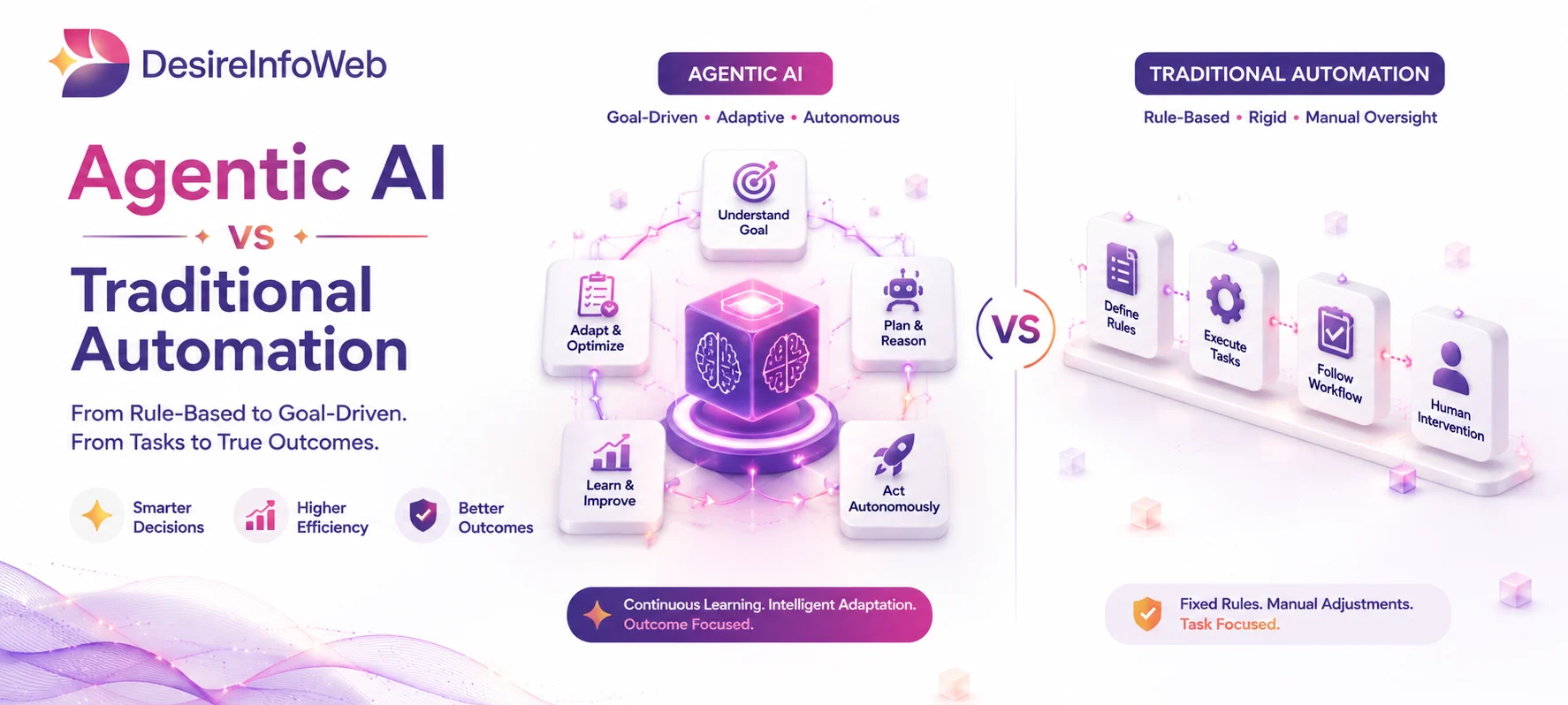
Traditional automation refers to software systems that execute predefined tasks based on fixed rules, workflows, and instructions. These systems are highly effective for repetitive and structured processes where every step is clearly defined.
Where Traditional Automation Wins
- Payroll processing with fixed rules and consistent data formats
- Scheduled report generation from structured databases
- Invoice data extraction from standardized templates
- Email routing based on fixed keywords or sender addresses
- System-to-system data synchronization on fixed schedules
Where Traditional Automation Struggles
- Customer-facing processes with highly variable requests
- Document processing with inconsistent formats
- Workflows requiring judgment and business context
- Complex multi-step business processes
- Tasks requiring exception handling without human intervention
What Is Agentic AI?
Agentic AI represents the next generation of intelligent automation. Unlike traditional automation systems that rely on predefined instructions, Agentic AI can understand objectives, reason through problems, make decisions, and take actions autonomously.
An AI agent can:
- Analyze business data
- Understand context
- Plan multiple steps
- Interact with systems
- Learn from outcomes
- Adapt to changing conditions
- Execute tasks independently
Instead of simply following instructions, Agentic AI focuses on achieving business goals.
Traditional automation is a vending machine. Put in the right coins, press the right button, get the right result.
Agentic AI is a capable employee. Give them a goal "Resolve this customer complaint" and they figure out the steps: check the order, review the policy, draft a response, escalate if needed, and close the ticket.
Agentic AI vs Traditional Automation: Key Differences
| Feature | Traditional Automation | Agentic AI |
| Decision-Making | Rule-Based | Goal-Oriented |
| Adaptability | Limited | High |
| Learning Capability | None | Continuous Improvement |
| Context Awareness | Minimal | Advanced |
| Complex Task Handling | Limited | Excellent |
| Human Intervention | Frequent | Reduced |
| Scalability | Moderate | High |
| Business Intelligence | Basic | Advanced |
| Real-Time Problem Solving | No | Yes |
Microsoft's Agentic AI Ecosystem: What's Available Right Now
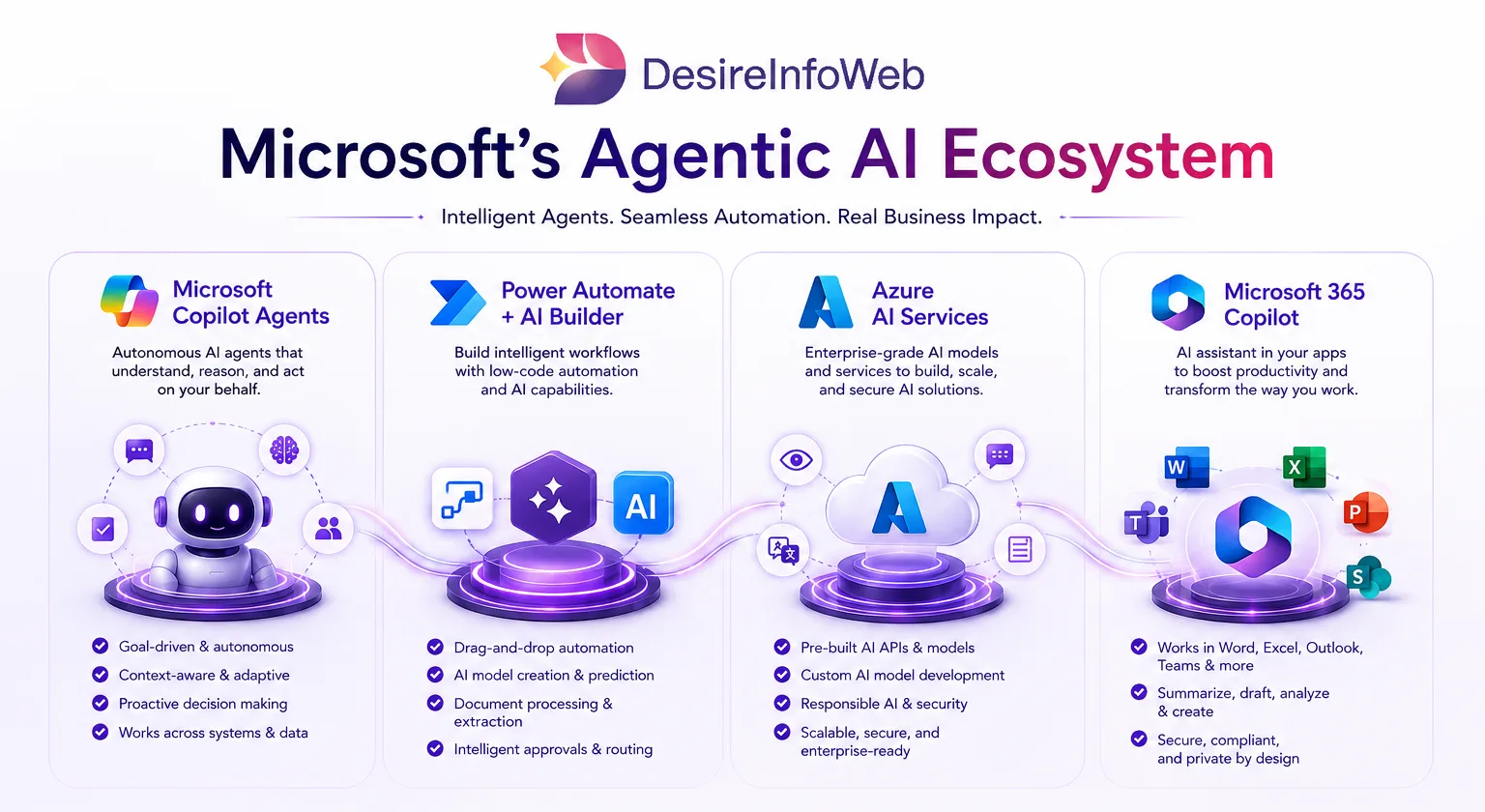
If your business already runs on Microsoft 365, you have a significant head start. Microsoft has embedded agentic capabilities throughout its ecosystem, many of which you may already be licensed to use.
Microsoft Copilot Agents
Copilot Studio allows you to build custom agents that are responsible for your SharePoint data, Teams conversations, and business applications. These are not chatbots; they are goal-directed agents that act.
Power Automate + AI Builder
The combination of Power Automates workflow engine with AI Builder's document intelligence and prediction models creates powerful agentic flows especially for document-heavy industries like legal, finance, and healthcare.
Azure AI Services
For enterprise-grade deployments, Azure OpenAI Service, Azure AI Studio, and Semantic Kernel provide the foundation for building sophisticated, multi-agent orchestration systems with enterprise security and compliance.
Microsoft 365 Copilot
Embedded directly in Word, Excel, Outlook, and Teams, M365 Copilot gives every knowledge worker an AI collaborator that takes action drafting, summarizing, extracting, and analyzing not just answering questions.
Why Businesses Are Moving Toward Agentic AI
- Better decision-making through contextual analysis
- Increased productivity for employees
- Enhanced customer experiences
- Reduced operational costs
- Greater business agility
Real-World Business Applications
Traditional Automation Use Cases
Traditional automation remains highly effective for:
Payroll processing
Form approvals
Data migration
Invoice workflows
Compliance reporting
Routine document management
Agentic AI Use Cases
Agentic AI excels in:
AI-powered customer service
Intelligent document processing
Sales assistance and lead qualification
Knowledge management systems
Supply chain optimization
Predictive maintenance
HR recruitment automation
Enterprise decision support systems
The more dynamic and knowledge-intensive the process, the greater the value Agentic AI can provide.
Cost Considerations
Traditional automation generally requires lower initial investment and works well for predictable tasks. However, maintenance costs can increase over time as workflows become more complex and business requirements evolve.
Agentic AI often requires a larger upfront investment but delivers greater long-term value through:
- Process optimization
- Reduced manual intervention
- Improved scalability
- Better customer experiences
- Faster decision-making
For organizations pursuing digital transformation initiatives, Agentic AI frequently provides stronger long-term ROI.
Which Approach Is Right for Your Business?
Choose Traditional Automation If:
- Processes are repetitive and predictable
- Workflows rarely change
- Business rules are clearly defined
- Compliance requires strict process control
- Budget constraints are a primary concern
Choose Agentic AI If:
- Workflows require decision-making
- Information changes frequently
- Customer interactions are complex
- Employees spend significant time searching for information
- Business growth requires scalable automation
Many organizations achieve the best results by combining both approaches, using traditional automation for structured processes and Agentic AI for intelligent decision-making.
Why Organisations Choose Desire InfoWeb for AI Automation
Desire InfoWeb is a Microsoft solutions partner specialising in Microsoft 365, SharePoint, Power Platform, and AI-powered automation for businesses across the USA, UK, Australia, Canada, Europe, and South Africa.
Our team doesn't just advise we implement. We've helped organisations across professional services, manufacturing, legal, and technology sectors move from manual processes to intelligent, agentic workflows using Microsoft's native toolset.
What We Bring
Deep expertise in Microsoft Copilot Studio, Power Automate, AI Builder, and Azure AI
Proven methodology for process discovery, automation design, and deployment
Ongoing support and optimisation not just a one-time build
Commercial clarity: we tell you exactly what you'll gain before you invest
Cross-industry experience: finance, legal, healthcare, professional services, retail
Desire InfoWeb is rated on Clutch, Upwork, and Google for Microsoft 365 consulting and SharePoint development.
Our clients don't choose us because we're the cheapest. They choose us because we deliver automation that actually works and we prove it before we ask for commitment.
Final Thoughts
The discussion around Agentic AI and Traditional Automation is not about choosing a winner. It is about selecting the right technology for the right business challenge.
Traditional automation remains highly effective for structured and repetitive processes. Organizations seeking greater agility, intelligence, and scalability are increasingly adopting Agentic AI to automate more complex workflows.
Businesses that embrace intelligent automation today will be better positioned to improve efficiency, enhance customer experiences, and drive sustainable growth in an increasingly competitive market.
If your organization is exploring AI-powered automation solutions, now is an ideal time to evaluate how Agentic AI can transform operations and accelerate digital innovation.