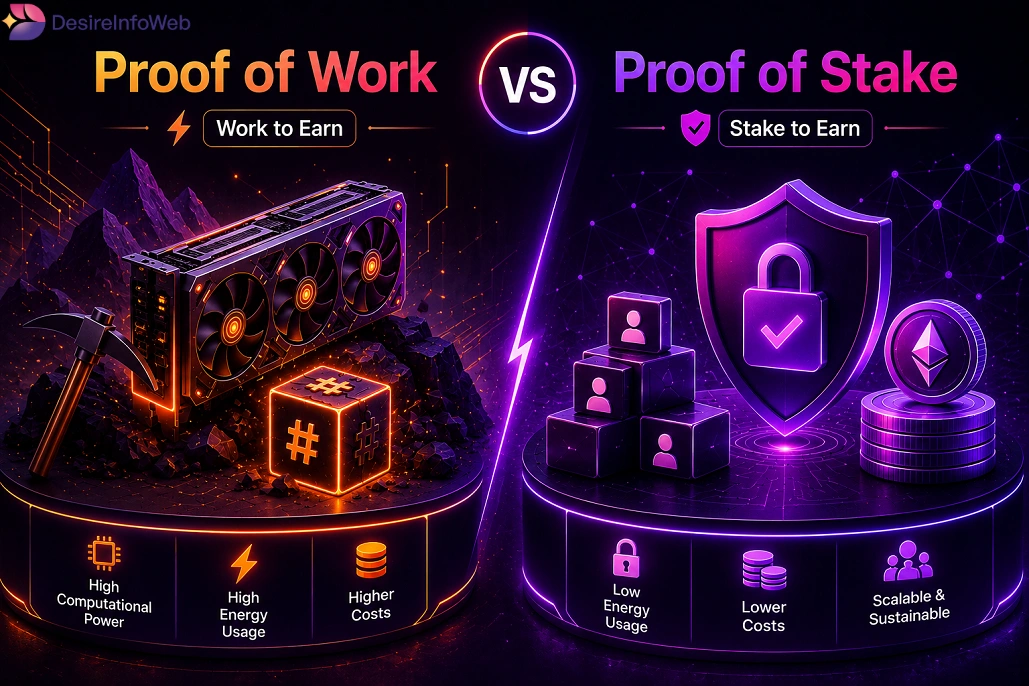
Blockchain networks rely on consensus mechanisms to validate transactions and maintain trust without a central authority. The two most used models are Proof of Work (PoW) and Proof of Stake (PoS). Understanding the differences between PoW and PoS is essential for anyone interested in blockchain technology, cryptocurrency networks, decentralized applications, and Web3 development.
What is a blockchain consensus mechanism and why is it essential for decentralized networks?
What Is a Blockchain Consensus Mechanism?
A consensus mechanism is a process that allows all participants in a Blockchain Network to agree on:
It ensures that every node in the network maintains the same trusted version of the blockchain.
- Valid transactions
- Blockchain updates
- The current state of the network
Why Consensus Mechanisms Are Important
Since blockchain operates without a central authority:
The network must prevent fraud
Avoid double spending
Maintain security
Ensure agreement across all nodes
Consensus mechanisms make this possible.
They help blockchain networks remain:
Decentralized
Secure
Trustworthy
1. What is Proof of Work (PoW)

Proof of Work (PoW) is one of the earliest and most widely known blockchain consensus mechanisms. It is primarily associated with Bitcoin.
In PoW, computers called miners compete to solve complex cryptographic puzzles. The first miner to solve the puzzle earns the right to validate transactions, create the next block, add the block to the blockchain, and receive rewards.
The first miner to solve the puzzle earns the right to:
Validate transactions
Create the next block
Add the block to the blockchain
Receive rewards
How Mining Works in PoW
- Step 1 — Collect Transactions: Miners gather pending transactions from the network.
- Step 2 — Create a Candidate Block: Transactions are grouped into a new block.
- Step 3 — Solve a Cryptographic Puzzle: Miners perform hashing calculations using different nonce values.
- Step 4 — Broadcast the Solution: The newly created block is broadcast for verification.
- Step 5 — Network Verification: Other nodes verify the block.
- Step 6 — Block Added to Blockchain: Once verified, the block becomes permanent and rewards are distributed.
Important Characteristics of PoW
High Security
Attacking the network requires enormous computational resources.
Energy Intensive
Mining consumes significant electricity and hardware resources.
Highly Decentralized
Many miners participate globally in securing the network.
Simple Analogy for PoW
The first person to solve it:
wins the competition
gets rewarded
earns the right to record the next page in a public ledger
2. What is Proof of Stake (PoS)

Proof of Stake (PoS) is a more energy-efficient consensus mechanism. Modern Ethereum uses Proof of Stake.
Instead of miners solving puzzles, PoS uses validators. Validators are selected based on the amount of cryptocurrency they stake in the network.
How PoS Works: Step-by-Step Guide
Simple Analogy for PoS: Participants lock security deposits, and the network selects trusted participants to validate records based on their stake. Dishonest behavior can result in losing deposited funds.
- Step 1 — Stake Cryptocurrency: Validators lock cryptocurrency as collateral.
- Step 2 — Validator Selection: The network selects validators using staking-related rules and algorithms.
- Step 3 — Validate Transactions: Selected validators verify transactions and create new blocks.
- Step 4 — Earn Rewards: Honest participation earns rewards.
Important Characteristics of PoS
Energy Efficient
- PoS consumes far less electricity compared to PoW.
Faster Scalability
- PoS networks are generally designed to support better scalability and efficiency.
Economic Security
- Validators risk losing their staked funds if they behave maliciously.
Simple Analogy for PoS
Imagine a system where participants lock security deposits. The network chooses trusted participants to validate records based on their stake in the system. If they act dishonestly, they risk losing their deposited funds.
Proof of Work vs Proof of Stake: Key Differences
Feature | Proof of Work (PoW) | Proof of Stake (PoS) |
|---|---|---|
Validation Method | Mining using computational power | Validation using staked cryptocurrency |
Participants | Miners | Validators |
Energy Consumption | Very High | Much Lower |
Hardware Requirement | Powerful Mining Hardware | Lower Hardware Dependency |
Security Model | Computational Difficulty | Economic Staking |
Example | Bitcoin | Modern Ethereum |
Which Consensus Mechanism Is Better?
Consensus mechanisms are the foundation of blockchain trust.
They help networks:
Validate transactions securely
Prevent fraud
Maintain synchronization
Operate without central authorities
Without consensus mechanisms, decentralized blockchain systems would not function reliably.
Consensus mechanisms allow Blockchain Networks to operate securely without relying on centralized control.
- Proof of Work (PoW) secures the network using computational power and mining.
- Proof of Stake (PoS) secures the network using staking and validator participation.