What Are Ethereum Accounts?
An Ethereum account is a core entity on the network that can store assets, send and receive transactions, and interact with smart contracts. The Ethereum network uses accounts to:
The Ethereum network uses accounts to:
- store ETH and tokens
- interact with smart contracts
- send and receive transactions
- maintain blockchain state
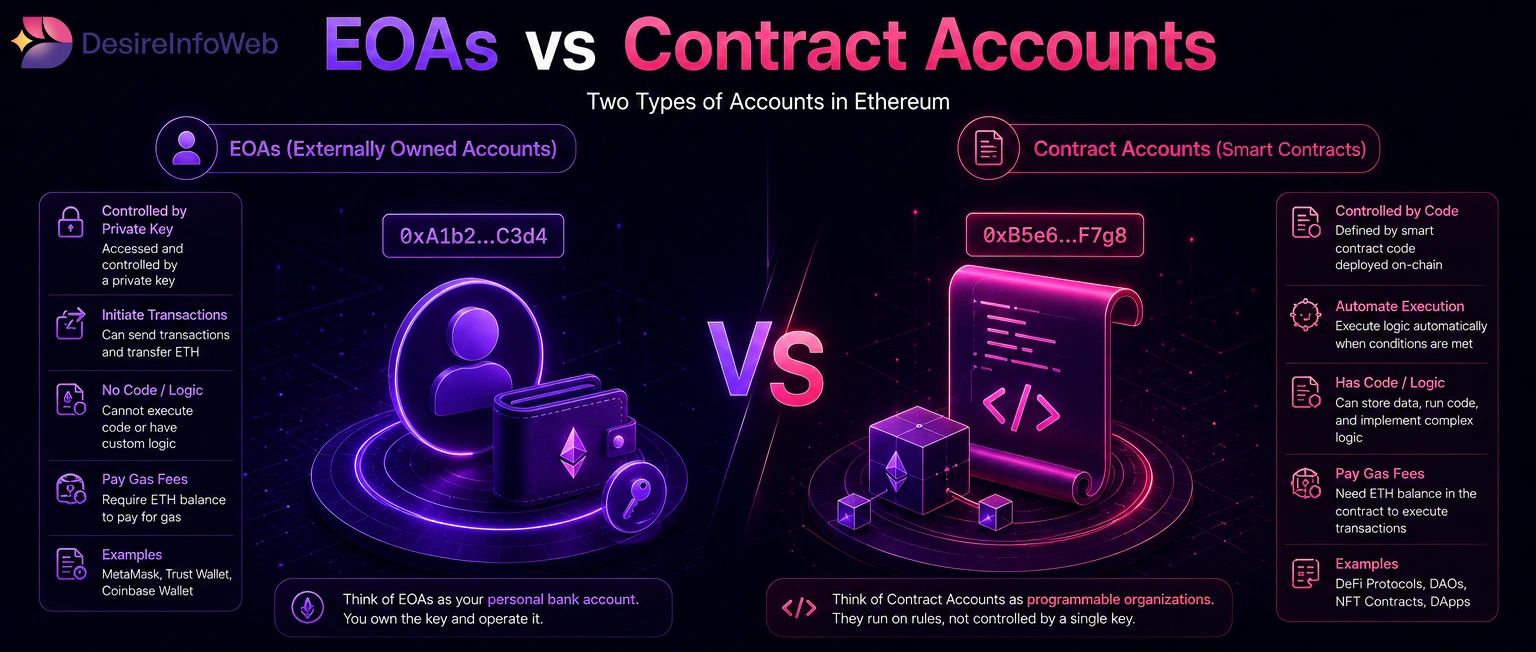
Ethereum mainly supports two types of accounts:
- Externally Owned Accounts (EOAs)
- Contract Accounts
Understanding these account types is important because every interaction on Ethereum happens through them.
Externally Owned Account (EOA)
An externally owned account (EOA) is a standard wallet account that is managed through a person with a non-public key.
This is the most common type of Ethereum account.
Examples:
- MetaMask wallet accounts
- Trust Wallet accounts
- Other crypto wallet applications
Key Features of an EOA
Controlled by a Private Key
An EOA is controlled directly by the account owner using a private key.
Only the person with access to the private key can authorize transactions from that account.
Can Send Transactions
EOAs can:
- send ETH
- transfer tokens
- interact with smart contracts
- deploy smart contracts
Can Hold Assets
EOAs can store:
- ETH
- tokens
- NFTs
- other blockchain assets
Understanding Keys and Wallet Addresses
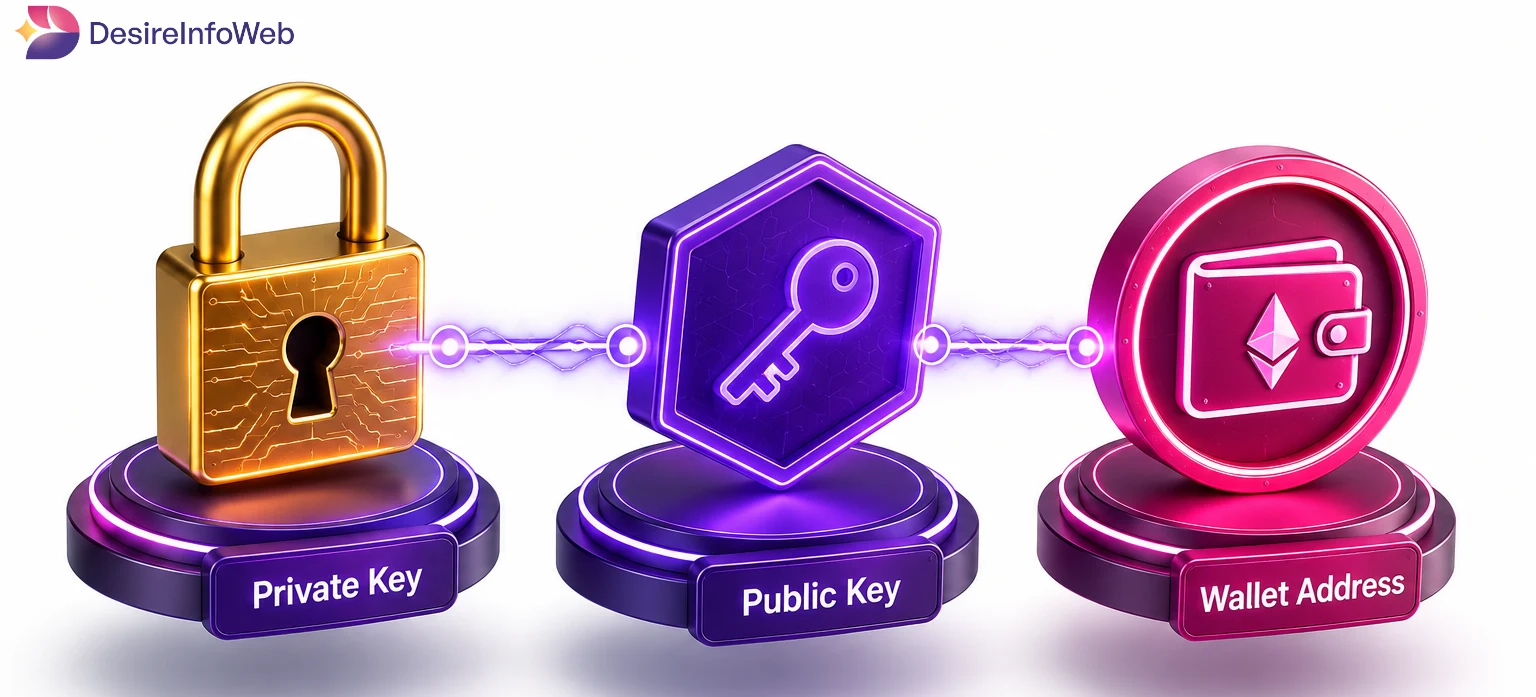
Private Key
A private key is a secret cryptographic key used to control the wallet. It should never be shared with anyone.
You can think of it as:
- The ownership credential of the wallet
- Whoever controls the private key controls the account.
Public Key
The public secret is generated from the private key. It is used in the process of creating wallet addresses and verifying cryptographic signatures.
Wallet Address
The pocket face is derived from the public key. This is the address users share publicly to:
- receive ETH
- receive tokens
- interact on the network
Every EOA is built upon a cryptographic key hierarchy that flows from a secret private key all the way to a public wallet address.
EXAMPLE WALLET ADDRESS
0x742d35Cc6634C0532925a3b844Bc454e4438f44e
2. Contract Accounts
A Contract Account is a blockchain account controlled by smart contract code instead of a private key.
Contract accounts contain:
These accounts contain:
- smart contract logic
- functions
- stored data
- blockchain state
Key Features of Contract Accounts
Controlled by Code
Unlike EOAs, contract accounts are controlled entirely by programmed logic.
They do not have private keys.
Execute Smart Contract Logic
Contract accounts automatically execute predefined functions when triggered.
Examples:
- token contracts
- NFT contracts
- decentralized exchange contracts
- voting systems
Store Data on Blockchain
Contract accounts can permanently store data and maintain application state on-chain.
Important Difference
EOAs Can Initiate Transactions
A user-controlled account can directly start blockchain actions.
Examples:
- sending ETH
- calling smart contract functions
Contract Accounts Cannot Initiate Transactions Themselves
Smart contracts only execute when:
- triggered by an EOA
- triggered by another smart contract
They do not independently start actions on their own.
A Simple Real-World Example
Imagine an online course platform built using smart contracts. Here is how the two account types interact in a single user journey:
| User (EOA) Sends Payment | → | Smart Contract Verifies Payment | → | Course Access Granted |
In this flow, the user wallet is an EOA the human-controlled initiator. The course logic runs entirely inside a contract account, automatically enforcing the business rules without any third-party involvement.
Difference Between EOA and Contract Account
| FEATURE | EXTERNALLY OWNED ACCOUNT (EOA) | CONTRACT ACCOUNT |
|---|---|---|
| Controlled By | Private key | Smart contract code |
| Can Initiate Transactions | Yes | No |
| Stores Smart Contract Logic | No | Yes |
| Used By | Human users | Blockchain applications |
| Holds ETH / Tokens | Yes | Yes |
Why Ethereum Accounts Matter
Ethereum accounts form the foundation of all blockchain interactions. They allow users and applications to:
| ★ | Transfer digital assets securely and without intermediaries |
| ★ | Execute smart contracts automatically on defined conditions |
| ★ | Manage and interact with decentralized applications |
| ★ | Participate securely in the on-chain ecosystem |
Conclusion
Ethereum accounts are the foundation of all interactions on the Ethereum Blockchain. By understanding the differences between Externally Owned Accounts (EOAs) and Contract Accounts, users can better understand how transactions, smart contracts, decentralized applications (DApps), and digital asset management work within the Ethereum ecosystem. Whether you are a beginner or an aspiring blockchain developer, understanding Ethereum account types is an essential step in learning Ethereum technology.