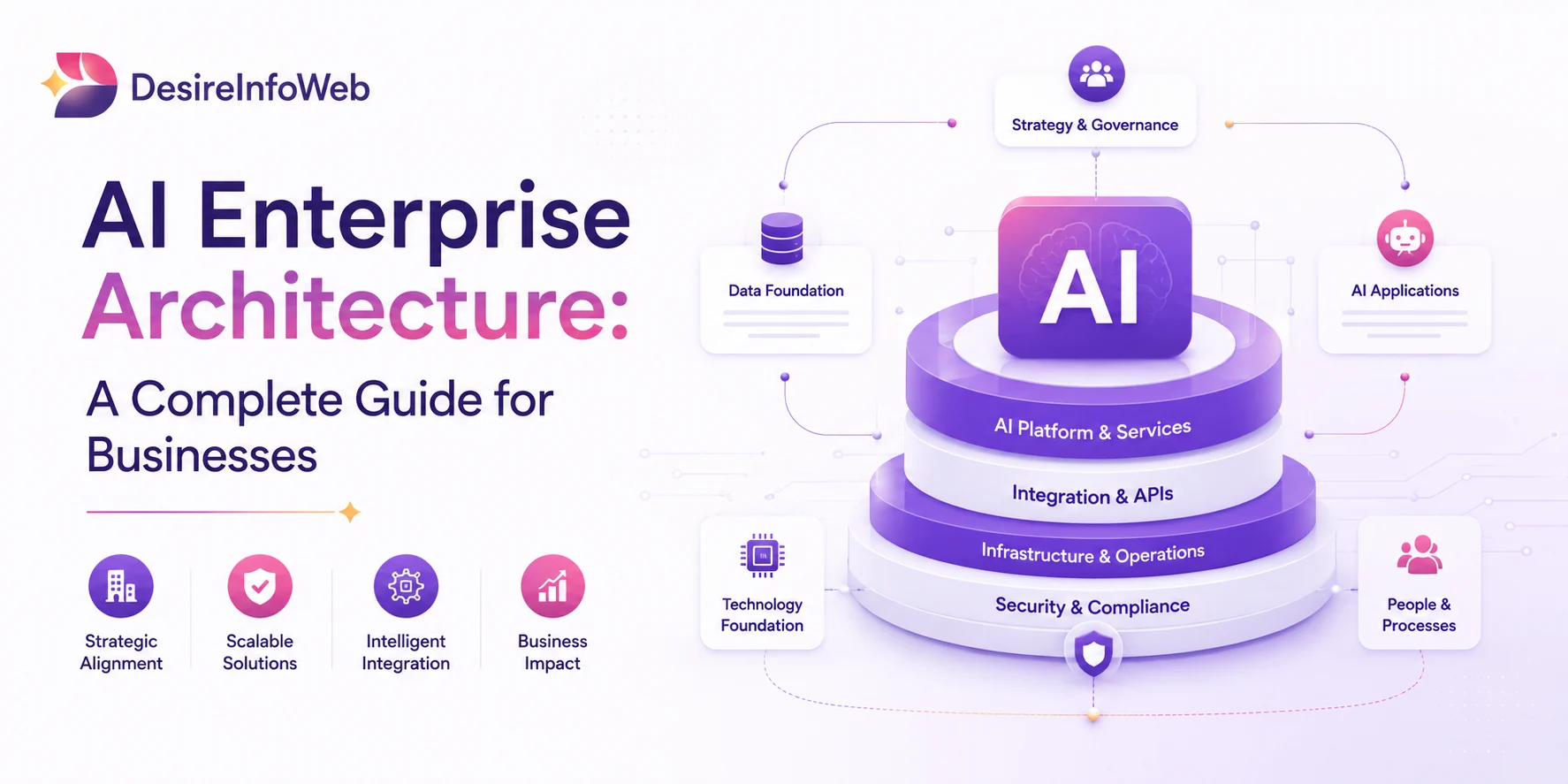
AI Enterprise Architecture is quickly becoming a must-have foundation for any business serious about adopting artificial intelligence. The era of Artificial Intelligence (AI) is no longer something companies will face in the distant future it's here now, actively used to automate processes, improve decision-making, enhance customer experience, and drive innovation. Yet most AI initiatives fail due to the absence of a proper enterprise architecture behind them.
Successful AI adoption isn't just about picking the right machine learning model or deploying a chatbot. To see real ROI, companies need a scalable, secure, and well-governed architecture that connects business processes, data, and technology and that's exactly what AI Enterprise Architecture provides.
Here is where the role of AI enterprise architecture comes into play.
A good AI enterprise architecture allows integrating the technology into business systems, ensuring security, compliance, and scalability. Whatever the implementation of AI (for instance, Microsoft Copilot, Azure OpenAI, automation via AI, and predictive analytics), a solid architectural foundation contributes to increasing ROI and minimizing the risk of failure.
Below, we break down what AI Enterprise Architecture is, why it matters, its core components, best practices, and how to design an AI-ready business ecosystem.
What Is AI Enterprise Architecture?
AI Enterprise Architecture is a structured framework that defines how artificial intelligence technologies, enterprise applications, business processes, data, governance, and security work together to support organizational goals.
Unlike traditional IT architecture, AI Enterprise Architecture focuses on enabling intelligent systems that can analyze data, automate workflows, generate insights, and continuously improve business operations.
An effective architecture ensures AI solutions aren't isolated projects but integrated business capabilities supporting every department from sales and marketing to HR, finance, operations, and customer service.
Why AI Enterprise Architecture Matters
Most companies kick off their AI implementation process with the use of individual tools without having in mind how they will fit into their existing systems. This leads to problems such as scattered data, poor user experience, governance issues, and higher costs of operation.
The proper AI enterprise architecture allows organizations to:
- Connect AI efforts with business goals
- Enhance data quality and availability
- Decrease implementation risks
- Enhance security and compliance
- Implement AI scaling
- Improve efficiency
- Boost digital transformation
- Optimize ROI
Instead of treating AI as a standalone tool, businesses can build an integrated environment where AI supports every business process.
Key Components of AI Enterprise Architecture
Constructing an effective AI architecture requires a number of interconnected pieces.
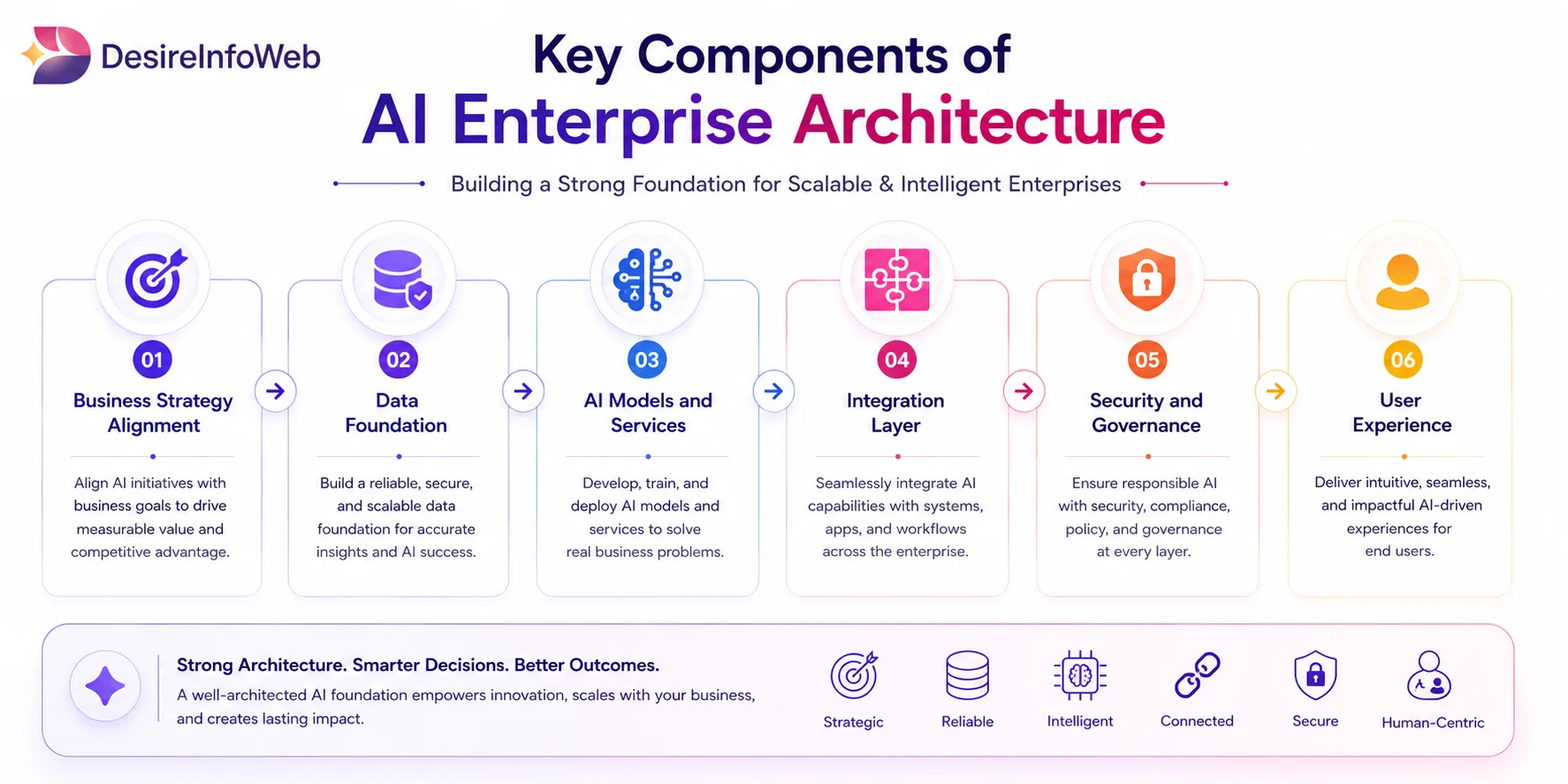
Business Strategy Alignment
Every AI implementation should contribute to achieving measurable business results.
Organizations should identify objectives such as:
- Improvement of customer experience
- Increase in employee productivity
- Automation of routine tasks
- Increased operational efficiency
- Increase in revenues
- Decision making based on data
Business goals should guide technology investments rather than the other way around.
Data Foundation
Organizations need a centralized, high quality, and well governed data environment that connects information from multiple sources, including:
- CRM systems
- ERP platforms
- SharePoint
- Microsoft 365
- SQL databases
- Cloud storage
- Business applications
- External data sources
Clean, consistent, and accessible data enables AI models to generate accurate and reliable insights.
AI Models and Services
The AI layer includes technologies that power intelligent business applications.
Examples include:
- Microsoft Copilot
- Azure OpenAI Service
- Machine Learning models
- Large Language Models (LLMs)
- Predictive Analytics
- Natural Language Processing (NLP)
- Computer Vision
Organizations should select AI services based on specific business requirements rather than adopting technologies solely because they are trending.
Integration Layer
AI should seamlessly integrate with existing enterprise systems.
Common integrations include:
- Microsoft 365
- SharePoint Online
- Microsoft Teams
- Dynamics 365
- Power Platform
- ERP systems
- CRM platforms
- Third party APIs
A connected ecosystem enables AI to access business data, automate workflows, and deliver contextual insights.
Security and Governance
Enterprise AI must prioritize security and compliance.
Governance should include:
- Role based access control (RBAC)
- Data classification
- AI usage policies
- Permission management
- Compliance monitoring
- Audit logging
- Responsible AI guidelines
Strong governance protects sensitive information while ensuring AI is used responsibly across the organization.
User Experience
AI adoption depends on employee engagement.
Organizations should provide intuitive interfaces that allow users to interact with AI through familiar applications such as Microsoft Teams, SharePoint, Outlook, and business portals. A seamless user experience encourages adoption and increases productivity.
Benefits of AI Enterprise Architecture
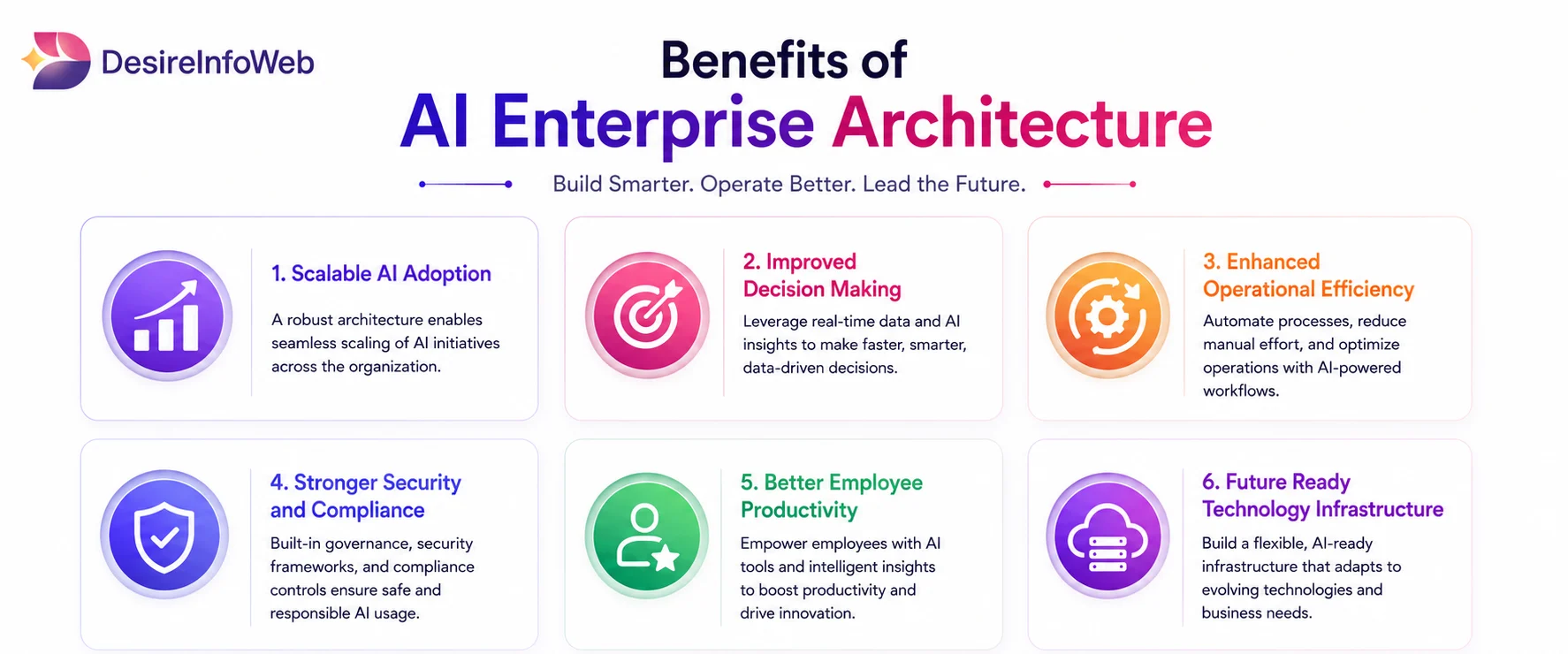
Scalable AI Adoption
A structured architecture allows organizations to expand AI initiatives across departments without rebuilding systems for every new project.
Improved Decision Making
AI powered insights help leaders make faster, more informed decisions using real time business data.
Enhanced Operational Efficiency
Automating repetitive tasks reduces manual effort and allows employees to focus on strategic initiatives.
Stronger Security and Compliance
A governance first approach helps organizations protect sensitive data while meeting industry regulations.
Better Employee Productivity
Employees spend less time searching for information and more time delivering value to customers and stakeholders.
Future Ready Technology Infrastructure
Organizations can adopt new AI capabilities without major infrastructure changes, ensuring long term flexibility and innovation.
Real World Use Cases of AI Enterprise Architecture
Customer Support
AI powered virtual assistants provide instant responses, retrieve knowledge from enterprise systems, and automate service requests.
Human Resources
Organizations use AI to streamline recruitment, employee onboarding, policy management, and internal support.
Sales and Marketing
AI analyzes customer behavior, predicts sales trends, generates marketing content, and improves lead qualification.
Finance
Finance teams use AI for forecasting, expense analysis, fraud detection, and automated reporting.
IT Operations
AI helps automate incident management, monitor infrastructure, and improve service desk efficiency.
Knowledge Management
AI Enterprise Architecture enables employees to quickly access policies, documentation, and organizational knowledge through intelligent search and conversational interfaces.
Best Practices for Building an AI Enterprise Architecture
Start with Business Objectives
Define clear goals before selecting AI technologies.
Build a Strong Data Strategy
Ensure data is accurate, accessible, and governed effectively.
Prioritize Security from Day One
Implement robust security controls, identity management, and compliance frameworks.
Choose Scalable AI Platforms
Select technologies that can grow with your organization and integrate with existing systems.
Encourage Cross Department Collaboration
AI initiatives should involve IT, business leaders, compliance teams, and end users.
Monitor and Continuously Improve
Regularly evaluate AI performance, user adoption, and business outcomes to refine your strategy over time.
Common Challenges Organizations Face
While AI offers significant opportunities, businesses often encounter challenges such as:
- Poor data quality
- Lack of governance
- Integration complexity
- Limited AI expertise
- Security concerns
- User adoption resistance
A well designed AI Enterprise Architecture addresses these issues by providing a structured roadmap for implementation and ongoing management.
How AI Enterprise Architecture Supports Microsoft Technologies
Organizations using Microsoft solutions can build a powerful AI ecosystem by integrating:
- Microsoft 365 Copilot for workplace productivity
- Azure Open AI Service for generative AI applications
- SharePoint Online for intelligent knowledge management
- Microsoft Teams for AI assisted collaboration
- Power Platform for workflow automation
- Dynamics 365 for AI driven customer engagement
- Microsoft Fabric for unified analytics and data management
This integrated approach enables organizations to create secure, scalable, and intelligent business solutions.
Why Partner with an AI Consulting Company?
Implementing AI Enterprise Architecture requires expertise in business strategy, cloud platforms, data management, security, and AI technologies.
An experienced AI consulting partner can help you:
- Assess AI readiness
- Design enterprise AI architecture
- Develop governance frameworks
- Integrate Microsoft AI solutions
- Build custom AI applications
- Optimize AI performance
- Ensure compliance and security
- Accelerate AI adoption
Professional guidance reduces implementation risks and helps organizations achieve measurable business outcomes faster.
Conclusion
AI is transforming the way businesses operate, but long term success depends on more than adopting the latest technology. A well designed AI Enterprise Architecture provides the foundation for scalable, secure, and business aligned AI adoption.
By connecting data, applications, governance, and intelligent automation, organizations can improve productivity, enhance decision making, reduce operational costs, and accelerate digital transformation.
Whether you're planning to implement Microsoft Copilot, Azure OpenAI, AI powered knowledge management, or enterprise automation, investing in a strong AI architecture today will position your business for sustainable growth and future innovation.

Frequently Asked Questions (FAQs)
What is AI Enterprise Architecture?
AI Enterprise Architecture is a framework that integrates AI technologies, business processes, data, governance, and enterprise applications to create scalable and secure AI solutions.
Why is AI Enterprise Architecture important?
It helps organizations implement AI strategically, improve security, ensure compliance, and maximize the return on AI investments.
What are the key components of AI Enterprise Architecture?
Core components include business strategy, data management, AI models, system integrations, governance, security, and user experience.
Can AI Enterprise Architecture integrate with Microsoft technologies?
Yes. It can seamlessly integrate with Microsoft 365, Azure OpenAI, SharePoint, Microsoft Teams, Dynamics 365, Power Platform, and other enterprise systems.
How can an AI consulting partner help?
An experienced consulting partner can design your AI architecture, implement governance, integrate AI with existing systems, train users, and ensure your AI initiatives align with business goals while maintaining security and compliance.